Elite Gate Repair in Evanston: A Homeowner’s Guide
A FAAC hydraulic operator that’s leaking fluid isn’t just an operator problem. It’s a hydraulic system problem, and a technician who treats it like a chain-drive LiftMaster will make it worse. That’s the thing about high-end gates on Evanston’s North Shore: they fail in specific, predictable ways, and the fix depends on knowing exactly which system you’re standing in front of. If you’d rather not sort through it yourself, call (833) 467-5627 and we’ll take a look.
What makes an elite gate system technically different?
An elite gate system differs from a residential-grade one in four technical areas, and each demands a different kind of repair knowledge. Hydraulic operators move oil under pressure instead of pulling a chain. High-cycle duty ratings mean the motor and gearbox are built for hundreds of daily cycles, not dozens. Integrated access control ties the gate to keypads, intercoms and loop detectors. And custom metalwork means the gate leaf, posts and columns were fabricated for that one driveway, not pulled off a shelf.
Why does that matter for repair? Because each of those systems has its own failure signature:
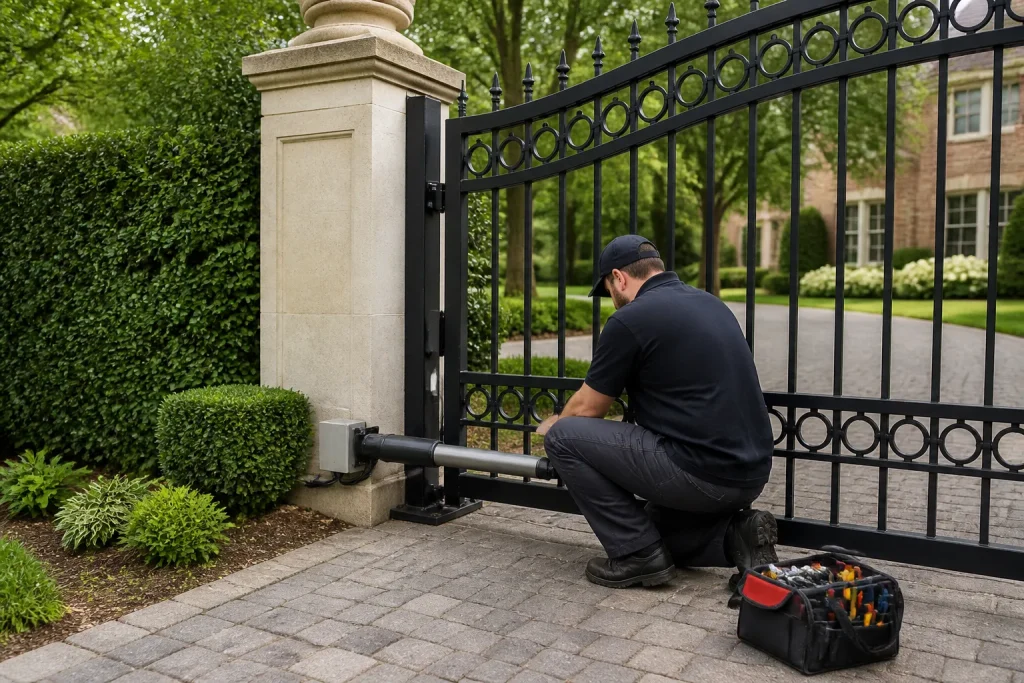
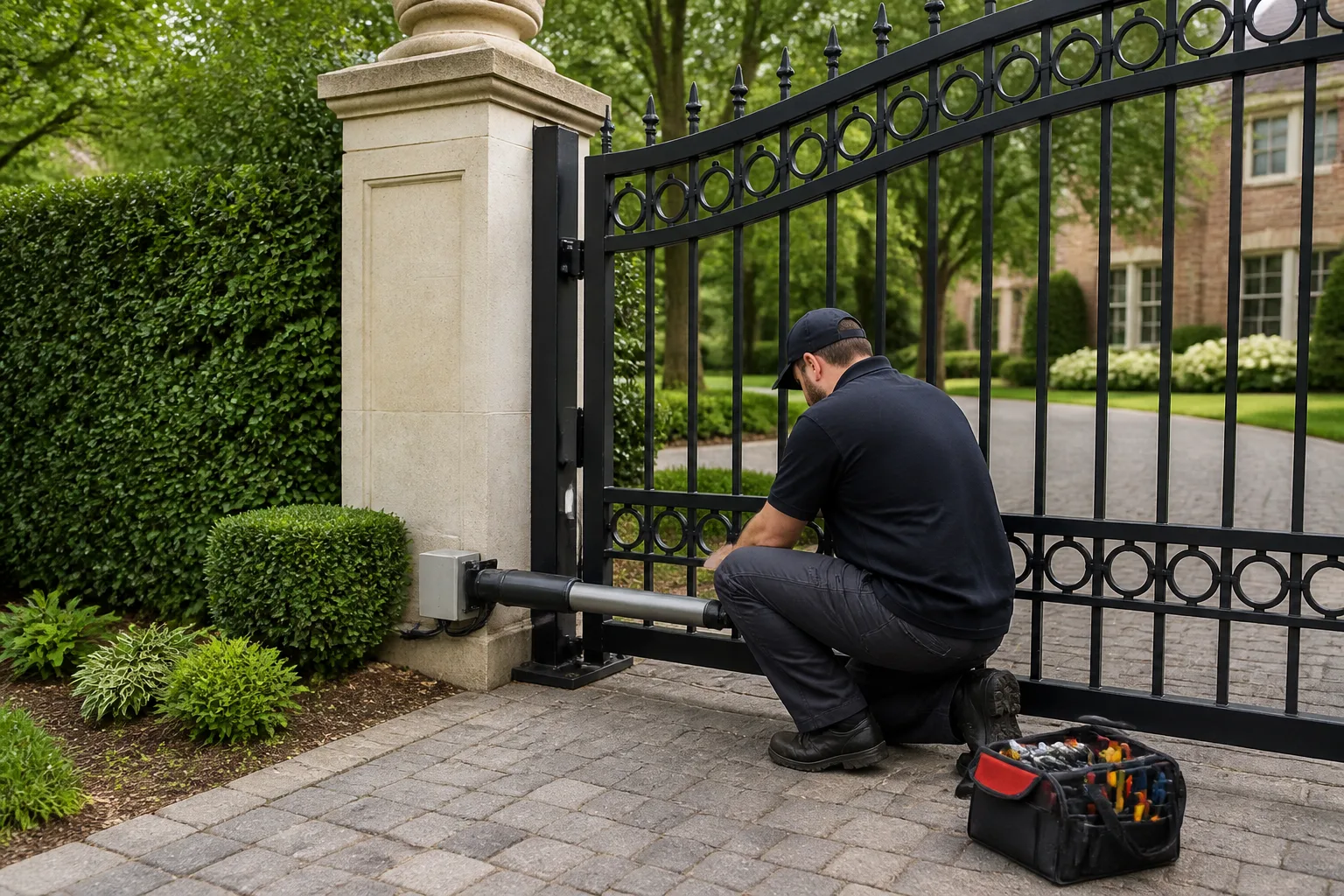
- Hydraulic operators (FAAC is the common example) fail at seals and fluid pathways, not at chains or belts. A technician trained on chain-drive units may top off fluid or swap a board without finding the actual leak source.
- High-cycle operators wear differently. Bearings, limit switches and control boards see far more actuations, so diagnostic steps that work on a light-use residential gate can miss the real wear point.
- Integrated access control sits at the boundary between the gate and the entry system. When a keypad or intercom stops triggering the gate, the fault could be in the gate operator, the wiring, or the access device itself. Sorting that out takes someone fluent in both.
- Custom metalwork means the gate was built to fit a specific opening. A sagging leaf or a shifted hinge line needs a repair that respects the original fabrication, not a generic bracket bolted on.
In Evanston, we see all four of these in the same neighborhoods, often on the same street. A gate that’s been running reliably for years can still develop a problem that a generalist misreads as “the motor’s shot” when it’s really a seal, a sensor, or a firmware mismatch.
The most common failure modes in North Shore high-end gates
Three failure patterns come up again and again on high-end gates around Evanston: FAAC hydraulic seal degradation, DoorKing firmware and compatibility issues, and custom column-to-post connections that shift over time. Each one looks like a different problem until you know what you’re looking at.
FAAC hydraulic seal degradation
Hydraulic operators rely on seals to hold fluid under pressure. Over seasons of freeze-and-thaw, those seals harden and start to weep. You might notice a slow drip under the operator, sluggish movement, or the gate stalling partway through a cycle. The trap is treating it as an electrical fault. A board swap won’t fix a leaking seal, and running the operator low on fluid can damage the pump. This is a hydraulic repair, and it needs to be diagnosed as one.
DoorKing firmware and compatibility issues
DoorKing entry systems are common on gated properties, and they’re robust. But when a control board, keypad or telephone-entry unit gets replaced or updated, firmware versions can fall out of step. The gate may open from one keypad but not another, or the intercom may ring without triggering the gate. These are compatibility problems, not mechanical ones, and they need someone with the right diagnostic tools and firmware access to sort out cleanly.
Custom column-to-post connections that shift
On a custom gate, the gate post is often tied into a masonry or steel column. Over time, ground movement, frost heave and the sheer weight of a heavy leaf can shift that connection. The gate starts to bind, drag, or hang unevenly. Left alone, that misalignment puts strain on the operator and shortens its life. The fix is structural, not just mechanical: the post and hinge line need to be brought back into true before the operator is asked to do more work.
If your gate is showing any of these signs, gate repair is the place to start. The sooner a specialist looks at it, the less likely a small seal or alignment issue turns into an operator replacement.
Why does manufacturer-authorized service matter more for elite brands?
Manufacturer-authorized service matters more for elite brands because the diagnostic tools, firmware access and parts channels are brand-specific. A technician without that access can still turn a wrench, but they can’t read the operator’s fault codes, update its firmware, or source the right internal components. On residential-grade equipment, the gap is smaller. On FAAC, DoorKing, BFT or Elite systems, it’s the difference between a real diagnosis and an educated guess.
Here’s what authorized familiarity actually gets you:
- Fault-code access. Modern operators log their own errors. Without the right tool, a technician is guessing at what the gate already knows.
- Firmware updates. Compatibility issues often resolve with a version match, not a part swap. Only someone with firmware access can do that.
- Correct parts. Hydraulic seals, control boards and limit switches vary by model. The wrong part can fit physically and still fail the system.
- Proper diagnostics on integrated systems. When the gate and the access control are one system, the diagnosis has to cover both. Our gate access control work covers keypads, intercoms, loop detectors and the operator side together, so nothing gets handed off.
We work on LiftMaster, FAAC, BFT, Linear, Viking, Ghost Controls, DoorKing, Elite and Mighty Mule systems. That range is deliberate: it means a homeowner with a Mighty Mule and a property manager with a DoorKing telephone-entry system both get a technician who recognizes the equipment on sight. Our technicians have up to 12 years of experience, all of it focused on gates rather than split across garage doors, fencing or landscaping.
Repair or upgrade? How to decide on an elite gate system
Repair usually wins when the operator is mechanically sound and the fault is a single component: a seal, a control board, a keypad, a limit switch. An upgrade to current-generation hardware makes more financial sense when the operator is at the end of its duty life, parts are hard to source, or the repair cost approaches the cost of a modern replacement. There’s no universal formula, but a few questions usually settle it.
- How old is the operator, and how hard has it worked? A high-cycle operator on a busy commercial entrance lives a different life than one on a quiet residential driveway.
- Is the fault isolated or systemic? One leaking seal is a repair. A pump, motor and control board all failing together points toward replacement.
- Are parts still available? Older or discontinued models can make repair slow and expensive. Current-generation hardware is easier to keep running.
- Has the access control kept pace? If the keypad, intercom or loop detector is outdated, upgrading the operator is a chance to bring the whole entry system current.
- What does the gate leaf itself need? If the custom metalwork is sound, repairing the operator makes sense. If the posts and hinge line are shifting, that has to be addressed either way.
We give you a straight answer on this, because a repair that’s going to fail again in a year doesn’t help anyone. When an upgrade makes more sense, we say so. New installation and motor replacement are part of what we do, and our gate motor & opener work covers both the mechanical and the access-control side of the change.
When to call a pro (and what a good service relationship looks like)
Call a professional when the gate involves hydraulics, high-voltage wiring, heavy moving panels, or integrated access control. Those are the areas where a mistake can injure someone or damage an expensive system. A gate operator carries line voltage, a hydraulic system is under pressure, and a heavy leaf that comes off its track can crush. This isn’t a job for a general handyman with a multimeter and good intentions.
For an elite system, a legitimate service relationship looks like this:
- Documentation. You get a record of what was diagnosed, what was replaced and why. That history saves time and money on the next visit.
- Component history. Knowing which parts have already been replaced tells the next technician where to look first.
- Maintenance that’s proactive, not reactive. A scheduled visit checks seals, alignment, sensors and access control before a failure strands you. It’s a one-time service priced per job after we look at the gate, not a contract you’re locked into.
- Honest recommendations. If a repair will hold, we repair. If an upgrade is the better call, we explain why.
If you’re in Evanston and your gate is binding, leaking, or ignoring its keypad, that’s the moment to call. A slow leak or a shifting post is easier and cheaper to fix early.
Related services in Evanston: Evanston Gate Repair handles the full range of automated and electric gate work, from diagnostics to installation, for homeowners, HOA managers and commercial properties.
The Bottom Line
Elite gate systems fail in specific ways, and the right diagnosis depends on knowing the brand, the operator type and the access control that’s wired into it. FAAC hydraulics need a hydraulic repair, DoorKing systems need firmware-aware diagnostics, and custom gates need a repair that respects the original fabrication. Repair usually makes sense when the fault is isolated; an upgrade makes sense when the operator is at the end of its life or parts are hard to find. Either way, a specialist who works on gates only will get you a straighter answer than a generalist who’s willing to try.
If you’re in Evanston and need help, Evanston Gate Repair offers free estimates. Call (833) 467-5627 and we’ll get your gate moving again.
Frequently Asked Questions
Usually not well. FAAC hydraulic operators need hydraulic-specific diagnosis, and DoorKing systems often need firmware access and compatibility checks that a general handyman won’t have. A generalist can sometimes swap a visible part, but the underlying fault often goes unfound. Call (833) 467-5627 for a specialist diagnosis.
It’s urgent, not necessarily an emergency. A slow leak can worsen and damage the pump if the operator keeps running low on fluid. Stop cycling the gate if you can and have it looked at soon. Call (833) 467-5627 for an assessment; estimates are free.
Repair usually wins if the fault is a single component and parts are still available. Replacement makes more financial sense when the operator is at the end of its duty life, several components are failing together, or parts are hard to source. We’ll give you a straight answer either way. Call (833) 467-5627.
Yes. We work on residential, commercial and estate-grade gates, including LiftMaster, FAAC, BFT, Linear, Viking, Ghost Controls, DoorKing, Elite and Mighty Mule systems. That covers a homeowner’s driveway gate and a property manager’s telephone-entry system on the same call. Call (833) 467-5627 for a free estimate.
Written by the team at Evanston Gate Repair.
Need Gate Repair Help?
Call Evanston Gate Repair - the local pro we connect you with is licensed and insured, here with fast after-hours help in Evanston.
(833) 467-5627